


Engineering and Mechanics of Under-Desk Walking Pad Treadmills
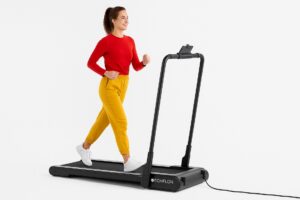
Have you ever considered doing anything to keep active while you’re at work? Walking pad treadmills allow you to walk slowly, which means you can keep active as you work at your desk. This gadget makes you get up and move about while you work, which means you spend less time sitting. Next, we’ll discuss the primary technological aspects, motor systems, and design characteristics that make walking pad treadmills easier to operate, quieter, and more efficient.
1. Core Components Overview
A basic walking pad machine has a few major pieces, such as the ones listed below:
- The frame and deck hold up the user and all the other pieces.
- A “walking belt” is a moving surface on which a person walks.
- The engine drives the belt’s movement.
- There are spherical sections called rollers that the belt passes around so that it may loop around them.
- The control system, which is an electrical interface, is responsible for timing, safety, and getting feedback from people.
- One beneficial thing about the shock absorption device is that it makes joints hurt less and makes less noise.
- Utilize equipment to monitor the speed, location, and safety conditions.
2. Designing the Frame and Deck
Materials:
Metal tubes composed of steel or alloys of steel and aluminum are used to construct the basis of foot pads. It is possible to say that these objects are both robust and lightweight. Because it is sturdy without being heavy, aluminum is a material that is more suitable for transporting and folding.
Integrity of the structure:
It is important that frames don’t bend or shake while individuals walk. Engineers may use finite element analysis (FEA) to figure out the optimal thickness and shape for the frame, ensuring it is sturdy yet not too heavy.
Building a deck:
The deck is the part of the belt that supports it and absorbs footsteps. It requires great effort to make this product. Usually, it has a plywood foundation with rubber or foam padding on top and a top layer that won’t wear out.
Ways to fold:
New hinge designs enable you to fold the deck up, down, or to the side. You may employ magnetic latches or mechanical locks to keep the deck either open or closed.
3. Walking Belt and Rollers
Material for the belt:
Either multi-layer polyurethane or polyvinyl chloride (PVC) is used to construct the belt, and it is woven with fabric to give it both a flexible and strong appearance. When it comes to preventing individuals from slipping, the top surface need to be rough.
How thick and strong it is:
Due to the belt’s thickness, which ranges from 1.5 to 3 millimeters, it is both robust and able to travel without any friction.
Rollers:
In order to move and guide the belt, we often make use of cylinders made of steel or aluminum that are between 40 and 50 millimeters in width. In addition to the fact that the front roller is connected to the motor drive, the tension on the rear roller may be adjusted to suit your needs.
Tracking and tensioning:
On the rear roller, there are screws that can be adjusted to ensure that the belt is always in the correct position and has the appropriate amount of tension. This is essential for ensuring that the operation is smooth.
4. Motor and Drive System
Type of motor:
The great majority of walking pads are driven by brushless direct current (BLDC) motors because of the outstanding silence, high efficiency, and long-lasting performance that these motors provide.
Power ratings:
The amount of electricity that some motors need ranges from 400 to 800 watts. This amount of power is sufficient to allow one to walk at speeds of up to six kilometers per hour without being too dehydrated.
Speed control:
PWM controllers or variable frequency drives (VFDs) are used to regulate the speed of the motor. The motor is able to accelerate and decelerate thanks to this technology, which eliminates bumps.
How to drive:
Belts or gears may be used to provide a direct connection between the motors and the front roller. Both noise and maintenance are reduced by using a direct drive.
5. User Interface and Control Electronics
Microcontroller unit (MCU):
The brain of the treadmill is responsible for handling inputs, communicating with other users, controlling the motor, and adhering to safety requirements.
Speed and position sensors:
These optical encoders, which are also referred to as Hall effect sensors, are used for the purpose of identifying the precise location and velocity of the conveyor belt. It is possible that the system with this configuration will be able to shut down on its own in the event that there is a problem if it is created in this manner.
Users in charge:
Through the use of remote controllers, touch panels, and applications for mobile devices, it is feasible to operate walking pad treadmills successfully. In addition to the simplification of the usage, users are provided with the possibility to change them. It is possible to communicate without the need of cables thanks to the modules that are included into Bluetooth and Wi-Fi.
Safety features:
In the event that you press the button for emergency stop or the magnetic key, the motor will immediately lose its capacity to establish a connection with the power source. Software has the ability to manage speed, but it also has the ability to detect when the belt is not aligned properly.
6. Absorption of Shock and Noise
Materials for cushioning:
As a result of the reduction in impact forces caused by the EVA foam or rubber cushions placed under the deck, the joints become less tight and loud.
Motor mounts that are separate:
Vibrations from the engine are prevented from going to the frame or the floor under the device by using mounts made of rubber or silicone.
Belt that cuts down on noise:
The application of coatings on belts reduces the likelihood that they will rub against one another and produce noise.
Quiet motors:
Because they do not have brushes and have fewer moving parts, BLDC motors are more silent than other types of motors.
7. Power Supply and Energy Efficiency
Input power:
The major responsibility of the motor controller is to transform the alternating current (AC) input, which ranges from 110 to 240 volts, into direct current (DC).
How to use energy:
It is necessary to have between 100 and 200 watts of electricity available for walking pad treadmills while they are in operation. When compared to full-size treadmills, this is a little amount.
Standby mode:
Current versions have low-power standby modes that help save energy when the device is not being used. These modes are included in newer versions.
8. Standards for safety and compliance
Certifications:
If you adhere to safety rules such as CE (Europe), UL (United States), and RoHS (environmental), you will be able to be certain that the electrical work and materials you use comply with safety standards.
How to keep from overheating:
Built-in temperature sensors are included into motors, and if the motor reaches an unsafe temperature, the motor is immediately turned off. This protects individuals and stops any harm from occurring.
Sensors for weight:
There are certain kinds that come equipped with weight sensors that are able to determine if the weight is uneven or too light. Keeping people safe is the purpose of this.
9. Durability and upkeep
Putting oil on the belt:
When the belt is lubricated on a regular basis, the amount of friction that occurs is reduced, which in turn enables the belt to survive for a longer period of time.
Cleaning:
In order to prevent the motor from overheating and the belt from wearing down, it is necessary to remove debris and dust.
Changing out worn parts:
In general, you should replace the rollers and belts every few years; however, the frequency of your use will determine how often you need to do this.
Changes to the firmware:
It is possible that software updates may, over time, enhance the performance of programs and perhaps give new features.
10. Problems and new ideas in engineering
A balance between portability and stability:
When it comes to material science and structural optimization, one of the most significant challenges is figuring out how to construct frames that are not only lightweight but also do not tremble.
Lessening noise:
The objective is to design treadmills using state-of-the-art motor technology and noise-reduction techniques so they may be used in mostly silent work environments.
The UI is easy to use:
In order to attract more users, it would be beneficial to make the controls simple to use and efficient when multitasking.
Connecting with smart ecosystems:
The goal of continuing research and development is to make wireless communication secure and reliable, even if it means using less power.
Using lightweight materials, powerful motors, intelligent electronics, and ergonomic design, walking pad treadmills that are made to be used under desks are incredible works of engineering. These treadmills are designed to be utilized so that they may be used beneath desks. You are able to store these treadmills below desks without any problems. Customers who have a large level of information about these technical aspects for themselves are better able to discern what technology is behind their health-improving goods and make more educated choices regarding the purchase and maintenance of this medical equipment. This is because customers are better able to determine what technology is behind their products.
- How to Choose the Perfect Under Desk Treadmill
- Are Under-Desk Treadmills Worth It Today?
- Appendix and Additional Resources Under-Desk Treadmills
- What Is a Walking Pad Treadmill Under Desk?
- Benefits of Using Walking Pad
- Walking Treadmill for Standing Desk
- WalkingPad A1 Pro Foldable Under Desk Treadmill
- How to Use Walking Pad Treadmills Under Desk Effectively
- User Testimonials and Case Studies
- Ultimate Buyer Guide to Walking Pad Treadmills Under Desk